The light cruiser Vicksburg laid a half-mile off the beach at Iwo Jima. Her 5-inch and 8-inch guns had pounded Mount Suribachi and the surround shoreline for days.

The light cruiser Vicksburg laid a half-mile off the beach at Iwo Jima. Her 5-inch and 8-inch guns had pounded Mount Suribachi and the surround shoreline for days.
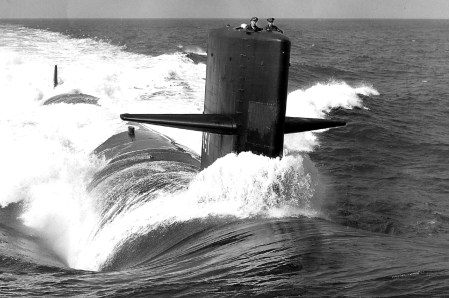
Chester M. “Whitey” Mack was skipper of the Lapon. It may have been the sharpest submarine in the U.S. Navy when he was at the helm.

As a child Pieter Kohnstam of Venice, Fla. grew up in Amsterdam, Netherlands during the late 1930s and early ‘40s. His family lived in an apartment house at 17 Merweideplein St. in a lovely section of the city’s south side.
Like a Biblical plague of locusts, the kamikazes swept across the Allied fleet in the Southwest Pacific during the closing months of World War II. The Japanese called them the “Divine Wind.” The sailors in Adm. “Bull” Halsey’s Task Force 38 called them “hell.”
Thomas Moore was an 18-year-old street-smart kid who grew up on his own in Monticello, N.Y. He joined the Navy on Sept. 10, 1940.
The Yamato was the largest battleship ever built. She had bigger guns and heavier armament than any ship afloat. Despite her size and fire power, the mightily leviathan’s hours were numbered as she and her small battle group steamed toward Okinawa on April 7, 1945.

Okinawa was the end of the line in the Pacific for the Japanese Imperial Army. The island invasion included 548,000 Allied forces and 1,200 ships. The initial assault force totaled 182,000 men – 75,000 more than landed on the beaches of Normandy on D-Day, a year earlier. They were facing 100,000 entrenched Japanese.
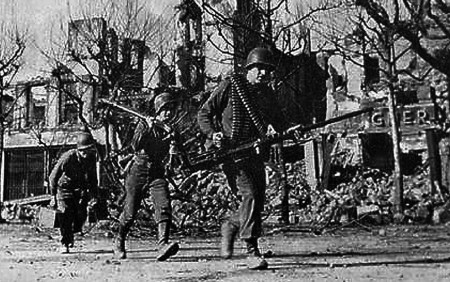
It was his baptism of fire. Ten days before, in early August 1944, 2nd Lt. Harry Long, a member of the Medical Administration Corps of the 318th Infantry Regiment, 80th Division landed on Utah Beach in Normandy, France as part of Gen. George S. Patton’s 3rd Army.

Charles Sass is a former platoon sergeant with the 511th Paratrooper Regiment. He made three combat jumps on Luzon Island in the Philippines during World War II.
Before Flying Officer George Stanton joined the 309th Polish Fighter Squadron in England during World War II, he spent 18 months in a Russian slave labor camp in Siberia chopping down trees.

Cpl. Randy Smith knew the war in South Vietnam was over when he was ordered to take down the American flag at the U.S. Embassy in Saigon.
Lt.j.g. Clyde Lassen’s Medal of Honor commendation On 19 June 1968 Lt. j.g. Clyde Everett Lassen, a member of Helicopter Support Squadron 7, Detachment 104, Republic of Vietnam was serving aboard USS Preble (DLG-15).

She emerged slowly from the car with cane in hand and walked hunched over along a serpentine concrete path. At its end was The Wall.
1st Lt. Marcella Zaborac of Englewood, Fla. came ashore on Normandy beach in August 1944 with Gen. George Patton. She served as a nurse with the 110th Evacuation Hospital in “Ol’ Blood-N-Guts” 3rd Army that fought its way across France and into Germany during World War II.

Capt. William Ecker who flew a secret low-level photo-reconnaissance mission over Cuba in 1962 to capture Soviet nuclear missiles on film during the Cuban Missile Crisis died last Thursday (Nov. 5, 2009) at his home in Punta Gorda, FL. He was 85.

Their target was a railroad marshaling yard along the German-Belgium border. Second Lt. Robert Grace was making his initial pass over the target at Prum, Germany in a P-47 Thunderbolt fighter plane on May 29, 1944 when he was shot down.

Lt. Charles Bailey, Sr. was the last of the line. He was the last of Punta Gorda, Fla.’s “Fighting Bailey Brothers.” The last of a family of seven sons and two daughters who distinguished themselves in war and in life during World War II, Korea and much of the 20th Century.
Bob Liebold of Englewood Beach, Fla. wears a tan ball cap with a brown beak. On the front of his hit are two gold crossed cannons, a couple of campaign ribbons with three bronze stars and on the beak is a set of silver captain’s bars.

Von Spahr, an Englewood, Fla. retiree, was a 19-year-old armorer in 1943 attached to the 431st Fighter Squadron, 475th Fighter Group, 5th Air Corps based at Port Moresby, New Guinea during World War II. His company commander told him to take a Jeep and pick up a pilot flying into the local airstrip in a…
Andy Knef joined the Navy in 1942 at 17 with his parent’s permission. Trained as an aviation machinist mate, he spent most of his time as a tail-gunner on a Martin Mariner (PBM) twin-engine seaplane flying combat missions in the Atlantic and Pacific.
When Staff Sgt.Chuck Walsh’s Green Beret unit jumped into Dak Pek, in the highlands of South Vietnam in 1962 to fight alongside the Montagnards, the indigenous people, they were trail blazers.
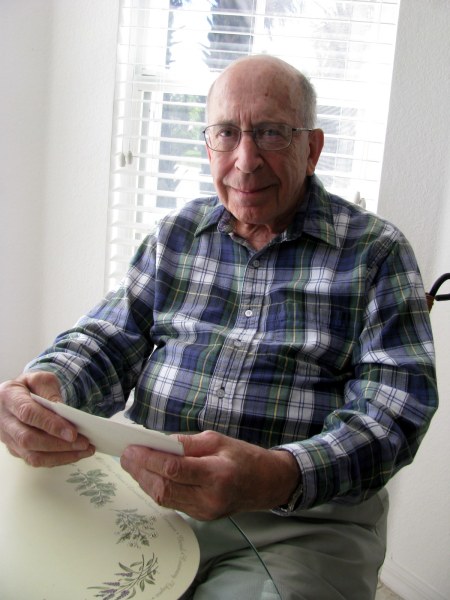
Bert Rockower was a corporal in the 9th Army that landed on Omaha Beach five months after D-Day during World War II. By then U.S. troops had advanced across France and liberated Paris. American forces were at the Siegfried Line, the massive concrete and steel fortification protecting Germany’s Western Front.
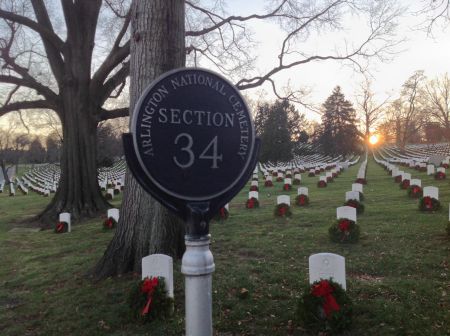
Harold Sandler didn’t start out to be a “Ninety-day Wonder” or a war hero, but that’s what he became by the time World War II was over.
The crippled German battleship Bismarck was just over the horizon, steaming erratically with two jammed rudders, the result of an earlier attack by ancient fabric-covered British torpedo bombers flying from the deck of the carrier HMS Ark Royal. The date was May 26, 1941.
 War Tales